The Art of Responsible Travel: Balancing Adventure and Ethics

- Responsible travel is the practice of designing an entire journey so that curiosity does not come at somebody else’s expense.* It is not a green label, a perfect score or one virtuous booking. It is the connected set of decisions that begins with choosing a route and continues through accommodation, transport, food, water, wildlife encounters, photography, spending and the stories told afterwards. The useful question is therefore not simply, ‘Is this trip ethical?’ It is, ‘Where can this journey create pressure, who carries that pressure, and what can I redesign?’
This approach keeps adventure alive. In fact, it often makes travel richer because it replaces passive consumption with attention. A road journey through Namibia offers a grounded example: distances are large, services can be sparse, water is precious and a destination that looks empty from a vehicle is never an empty stage. Planning well becomes part of respect. Ethics enters the route, the pace and the margin for the unexpected.
Responsible travel begins before the booking screen
Most tourism marketing starts with desire: a horizon, a room, a meal, a promise of escape. Responsible travel begins one step earlier, with consequences. What season will you enter? Is a place managing drought, congestion or pressure on housing? Does an activity depend on access that residents also need? What will your arrival demand from workers, roads, waste systems and ecosystems? These questions do not require travellers to become auditors. They simply prevent the destination from being reduced to scenery.
A useful planning page has four columns: movement, resources, relationships and evidence. Under movement, note distances and realistic travel time. Under resources, record water, energy and waste constraints. Under relationships, identify who owns and delivers each experience. Under evidence, keep the policies or practices that support a sustainability claim. The GSTC Destination Standard offers a strong reference because it connects environmental management with community participation, decent work, local enterprise, heritage and visitor pressure. It makes clear that sustainability is a system, not a photograph of solar panels.
This preparation changes buying behaviour. Instead of comparing only price and appearance, compare cancellation terms, transport needs, length of stay, local supply chains and the provider’s explanation of its impact. A more expensive room within walking distance of several activities may create a lighter and more coherent journey than a cheaper isolated room requiring repeated drives. Ethical tourism becomes concrete when trade-offs are visible.
Design the route, not a race across the map
A map compresses distance. A social feed compresses it again, placing a dune, a coastal town and a wildlife sighting in three adjacent frames. The road does not. In Namibia, long stretches, gravel surfaces, heat, changing visibility and limited fuel points make a rushed itinerary both exhausting and unwise. A responsible route accepts the physical scale of the country. It schedules driving in daylight, checks current road and park information, carries water, respects speed and allows recovery time between major legs.
That is not a call to simulate a hardship expedition. It is a design principle: build slack into the journey. A buffer makes it less tempting to speed, pressure a guide, arrive after agreed hours or treat every pause as a failure. It also makes room for local advice. If conditions change, the itinerary can change without pushing the cost onto a driver, host or landscape. Where public transport is practical, it may be useful; where it is not, responsible travel means sharing a vehicle, reducing unnecessary backtracking and staying longer rather than pretending every geography offers the same mobility options.

A Namibia road journey makes distance, preparation and pace visible parts of the experience.
Slow travel is often described as an aesthetic: unhurried breakfasts and time to wander. Its ethical value is more practical. Fewer transfers can reduce resource use and administrative strain. Repeated visits to the same café, market or neighbourhood allow context to accumulate. The traveller stops demanding that every encounter produce instant novelty. Time changes the relationship from extraction—take the image, collect the fact, move on—to presence.
Follow the money beyond the word ‘local’
Spending locally is important, but the word ‘local’ can hide as much as it reveals. A lodge may stand in a region while ownership, purchasing and profits sit elsewhere. A tour may employ local guides but give them no influence over the narrative. A craft shop may use regional motifs on imported goods. The better question is not whether an offer looks local; it is how value moves through it.
Look for specific signals: locally owned or meaningfully shared ownership; visible local purchasing; fair employment; opportunities for training and advancement; reasonable group sizes; transparent community agreements; and honest descriptions of what visitor fees support. The GSTC criteria on hotels and accommodation explicitly connect cultural presentation with community views and intellectual property. That is more useful than a vague promise of authenticity.
Price is part of the relationship. Bargaining can be customary in some settings, but treating every exchange as a contest can make a trivial saving for the visitor and a meaningful loss for the maker. Ask whether negotiation is expected. Notice the labour, skill and materials in front of you. Buy fewer things with clearer provenance. When booking guides or small operators, read cancellation policies as mutual protection rather than an obstacle. A deposit may secure a person’s time, transport and supplies long before you arrive.
A platform can help discovery without replacing judgment. For Namibia, Ayivoo can be approached as one editorial starting point for finding locally rooted places and experiences; travellers should still verify the current offer, ownership, terms and suitability directly. The point is not to outsource ethics to a directory. It is to widen who gets considered when attention and spending are distributed.
Water, energy and waste belong in the itinerary
Resource use often disappears behind hospitality. A tap runs, towels return clean and bins empty as if the system had no edge. In arid environments, that illusion is especially misleading. Water-conscious travel begins by learning what the accommodation asks of guests, then following those practices without turning deprivation into theatre. Shorter showers, sensible laundry requests, refillable bottles where safe water is available and reporting leaks are modest actions. Their value grows when providers also measure use, maintain systems and adapt landscaping, kitchens and operations.
Energy choices are similarly contextual. Air conditioning, refrigeration and hot water may be essential to comfort and safety, while supply conditions vary. Guests can avoid cooling an empty room, close doors and use equipment as instructed. More importantly, they can favour businesses that describe operational measures rather than merely display an eco badge. Ask what is measured, what has improved and what remains difficult. Honest limits are more credible than perfection.
Waste planning starts before departure. Reusable containers help only when they suit the place and can be cleaned safely. Remove excess packaging at home, carry batteries back when proper disposal is uncertain and avoid bringing disposable ‘solutions’ that become somebody else’s problem. On a road journey, secure all waste and never assume a remote bin has a reliable collection chain. The aim is not photogenic zero waste; it is reducing material that local systems must absorb.
Cultural respect is built through permission and context
Culture is not an attraction that waits unchanged for a visitor. It is lived, debated and renewed by people who are not obliged to perform it. Learn basic greetings and local etiquette, but avoid turning a short preparation list into confidence that you understand everything. Ask the guide or host what is appropriate. Pay attention to who is speaking, who is translating and who has the authority to invite visitors into a space.
The World Intellectual Property Organization’s explanation of traditional cultural expressions is a useful reminder that designs, music, symbols, stories, ceremonies and craft can carry rights and collective meaning. Something visible is not automatically free to copy. A pattern encountered on a journey should not become a brand asset, tattoo, product or campaign reference simply because its origin feels difficult to trace.
Permission must be specific. Agreement to attend a demonstration is not necessarily agreement to record it. Permission to photograph an object is not permission to sell the image. A guide’s invitation may not override the wishes of the person in front of the camera. When uncertain, lower the phone and stay present. Responsible travel creates memories that do not all require proof.
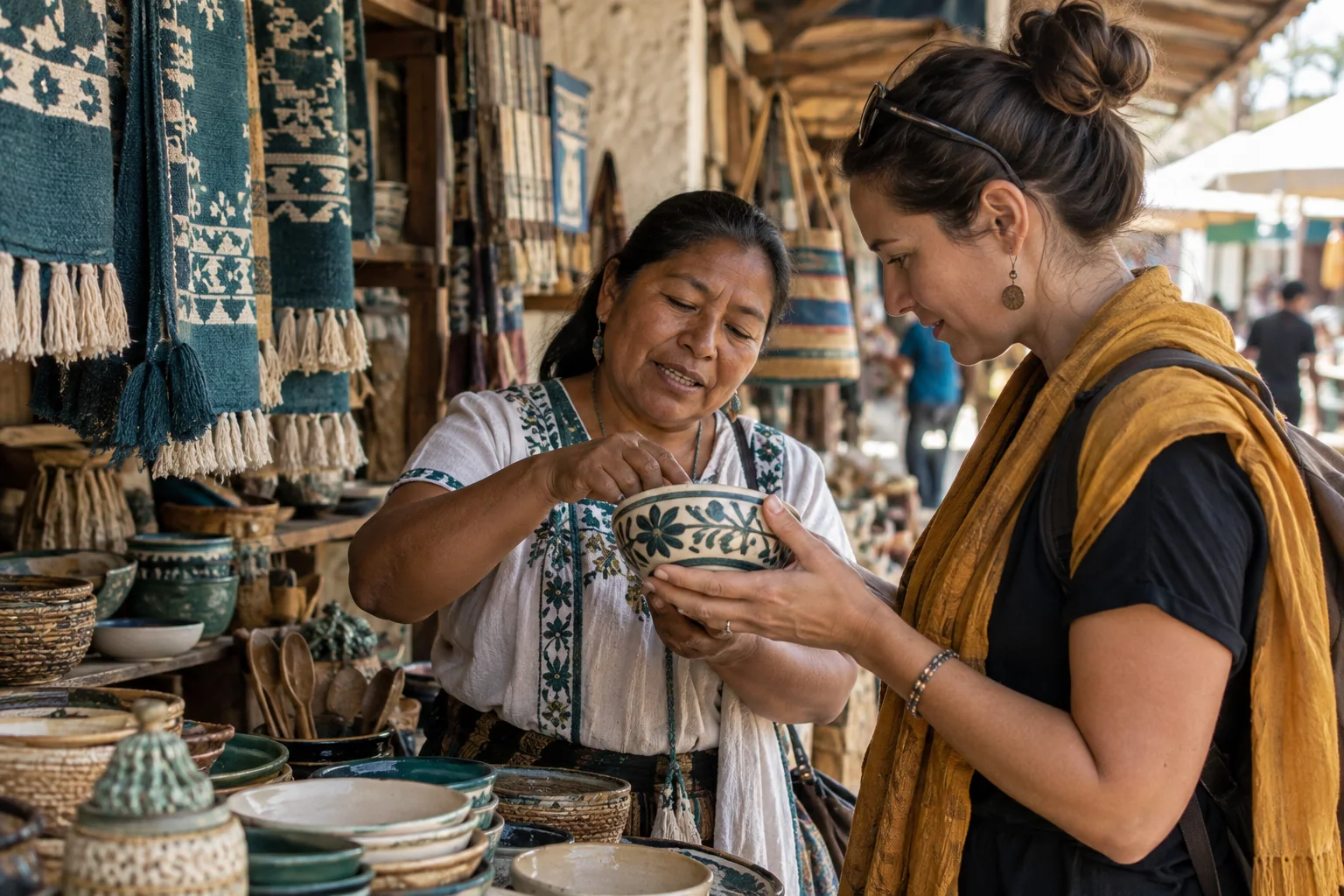
Editorial illustration: learning from an artisan requires attention, permission and a fair exchange.
Photography continues the relationship after departure
A photograph can preserve attention, but it can also flatten a person into atmosphere. Before taking one, ask whether the subject can freely refuse. Children require particular care; a charming image is not a reason to bypass a guardian or the child’s dignity. Avoid photographing people in vulnerable, medical, religious or private situations unless the context and consent are unmistakably appropriate. Never attach an invented biography to make a post more moving.
Captioning matters. Name a place only when certain. Distinguish what you observed from what you inferred. Do not describe a staged tourism activity as timeless daily life. Credit artists and guides when they want attribution, and ask how they prefer to be named. If a person later requests removal, treat that as part of the original relationship rather than an attack on your creative freedom.
The same discipline applies to brands and travel businesses. A content plan should include a consent process, a record of usage rights, review for sensitive details and a route for correction. Our article on everyday objects as cultural signals explores why interpretation must remain contextual. For organisations developing travel storytelling, creative production should be designed around those responsibilities from the brief onward.
Wildlife encounters need distance, not drama
Wildlife tourism can finance conservation and livelihoods, yet good intentions do not make every encounter responsible. Avoid experiences that depend on touching, feeding, baiting or crowding wild animals for a closer image. Follow park rules, guide instructions and distance limits. Never ask a driver to leave an authorised route or prolong a sighting when the animal is showing stress. A quiet departure can be the most respectful part of the encounter.
Do not interpret stillness as consent. Animals conserve energy, protect young and respond to pressure in ways visitors may not recognise. Ethical operators set expectations before the sighting, refuse unsafe requests and manage group behaviour. Travellers can support that authority by not rewarding the loudest or most intrusive guide with praise and tips.
Responsible marketing also resists guaranteed-sighting language when nature cannot guarantee an appearance. The absence of an animal is not a service failure. It can become a lesson in habitat, seasonality and the limits of human control. That shift—from wildlife as inventory to wildlife as living presence—changes both the experience and the story later told about it.
Certification is evidence, not absolution
Labels can reduce search costs, but no badge can answer every question. Check who created the standard, what it covers, whether assessment is independent, how often compliance is reviewed and whether complaints are visible. The GSTC explains that recognition of a standard and accreditation of certification are distinct; recognising that distinction prevents a logo from carrying more meaning than it should.
Evidence can also be modest and specific: a published water policy, local procurement examples, staff development, clear animal-welfare rules, accessible grievance channels, a community partnership with defined decision rights. One small provider may lack formal certification while demonstrating thoughtful practice. Another may hold a badge yet communicate poorly about the parts relevant to your trip. Use standards as a common language, then keep asking practical questions.
Beware of the traveller’s desire for moral innocence. Carbon calculations, donations and certified stays can support better choices, but they do not erase impact. Offsetting should never become permission for unnecessary consumption. The more honest goal is reduction, contribution and continuous correction—not a receipt proving that nothing complicated happened.
Make the people travelling with you part of the design
Ethics fails when it lives only in one person’s private intentions. Before departure, agree on group rules: no photographing people without permission; no pressure on guides to break rules; shared expectations about water and waste; a realistic driving schedule; a budget that allows fair payment; and a method for resolving disagreements. Families can involve children without turning them into sustainability police. Explain why a choice matters and give them meaningful roles.
Accessibility belongs in the same conversation. A slower pace, clear information, planned rest and flexible activities can make a journey more inclusive. Do not assume a disability is visible or that one traveller’s needs are an inconvenience to the ‘real’ adventure. Ask providers precise questions about steps, surfaces, bathrooms, transport, sensory load and assistance. Honest descriptions help everyone plan.
When trade-offs arise, decide transparently. A traveller with limited time may need a flight. Someone with health requirements may need packaged supplies or continuous cooling. Responsible travel is not a purity contest; it is proportional attention to what can genuinely be changed. Shame hides constraints. Design makes them discussable.
Use a decision framework while the journey is happening
A simple pause can prevent many poor choices. Ask five questions: What is happening here? Who benefits? Who bears the cost? What permission or evidence is missing? Is there a lower-pressure alternative? The framework applies to a souvenir, a shortcut, a photograph, a wildlife encounter or a last-minute excursion. It converts ethics from a grand identity into a repeatable practice.
Build in review points. At the end of a driving day, check fuel, water, waste and tomorrow’s distance. After an experience, ask whether the description matched reality and whether people had agency in how their culture was presented. If something felt wrong, raise it calmly with the provider when safe, document facts and avoid broadcasting accusations before understanding the situation. Accountability should be accurate as well as visible.
Brands can apply the same logic to customer journeys. Our guide to the design of ordinary experiences shows how small handoffs expose the real quality of a promise, while small frictions can identify where a system transfers effort onto people. For tourism organisations, brand strategy should connect the promise of responsibility to operations, incentives and proof.
Responsible travel includes what you do afterwards
The trip does not end when the luggage is unpacked. Pay outstanding balances promptly. Leave a precise review that rewards practices worth repeating: a guide who protected distance around wildlife, a host who explained water constraints, a business that credited makers clearly. Avoid praising ‘untouched’ or ‘undiscovered’ places; such language erases residents and can accelerate the pressure you claim to admire.
Sort images with consent and context in mind. Share fewer, better-captioned photographs. Correct mistakes publicly when needed. If you learned from an artist, organisation or community initiative, keep their name attached to the knowledge. If you promised to send an image, send it. These small acts turn a fleeting encounter into accountable follow-through.
Then review the journey as a prototype. Which transfer created unnecessary stress? Where did spending remain local? Which claim proved vague? What would you book differently next time? Teams use retrospectives because good systems improve through evidence; travellers can do the same. Our discussion of turning intuition into a system offers a related way to preserve learning without freezing it.
Responsible travel is a better way to pay attention
The art of responsible travel is not balancing adventure against ethics as if one must shrink for the other. It is recognising that ethics can design a more attentive adventure. A well-paced route reveals distance. A fair exchange reveals skill. A restrained camera allows an encounter to remain an encounter. A wildlife sighting gains meaning when the animal is not forced to perform. Limits become part of the place rather than obstacles to consuming it.
No traveller controls the whole tourism system, and no itinerary is impact-free. Yet every journey distributes money, time, visibility and pressure. Designing those flows deliberately is real agency. Begin before the booking, keep asking while on the road and remain accountable after returning. The result is not moral perfection. It is a journey in which curiosity travels with humility—and leaves more room for the people and places that made discovery possible.
Author

Kettely BLARY
Kettely Blary is a founder with a distinctive approach, driven by a deep interest in how ideas evolve—from their earliest spark to their full realization in the tangible world. The author of To Make a Faun Sit and Mapipis, she explores in both her writing and her projects the moment when intuition takes shape—when something abstract becomes real and embodied. As the head of KB Ayilink, she develops and leads projects that carry ideas beyond their original scope. Her work reflects a strong sense of balance between structure and movement, intention and execution, and individual expression and collective dynamics. Across everything she does, she is guided by a simple belief: ideas truly come into their own when they find their most compelling form in the real world.